NexusClaw
NexusClawEnterprise Applications & Digital Employee Platform
← All capabilities

Digital Workforce / Product Proof

Not a chatbot.A governed digital employee.

NexusClaw makes AI employees real execution subjects inside enterprise systems: identity determines authority, work definitions determine capability, and approval plus audit determine how critical actions are controlled and traced.

The interfaces below are current product surfaces, not conceptual renders. Follow one evidence path across identity, configuration, execution, human control, and audit.

AI employee command centerNexusClaw Product UI
NexusClaw AI employee command center product interface
See workforce readiness, governance queues, risk blocks, and operating health with operations, training, insight, governance, access, and platform navigation fully expanded.

01 / Identity & Authority

Start with the enterprise question that matters: who does this action represent?

Identity is an authorization rule, not a profile label. NexusClaw supports exactly two identities and rejects ambiguous half-configured states.

Independent employee

Independent employee

Uses a dedicated service account and role, acting as its own authorization subject with explicit job, organization, data access, and audit identity.

  • Designed for persistent job ownership
  • Authority comes from a dedicated role
  • Execution records belong to the employee
Assistant

Assistant

Has no independent service account and inherits the authenticated task initiator’s authority. If the user cannot access an object, the assistant cannot cross that boundary.

  • Designed to assist a specific user
  • Authority follows the user and task
  • No misleading standalone access settings
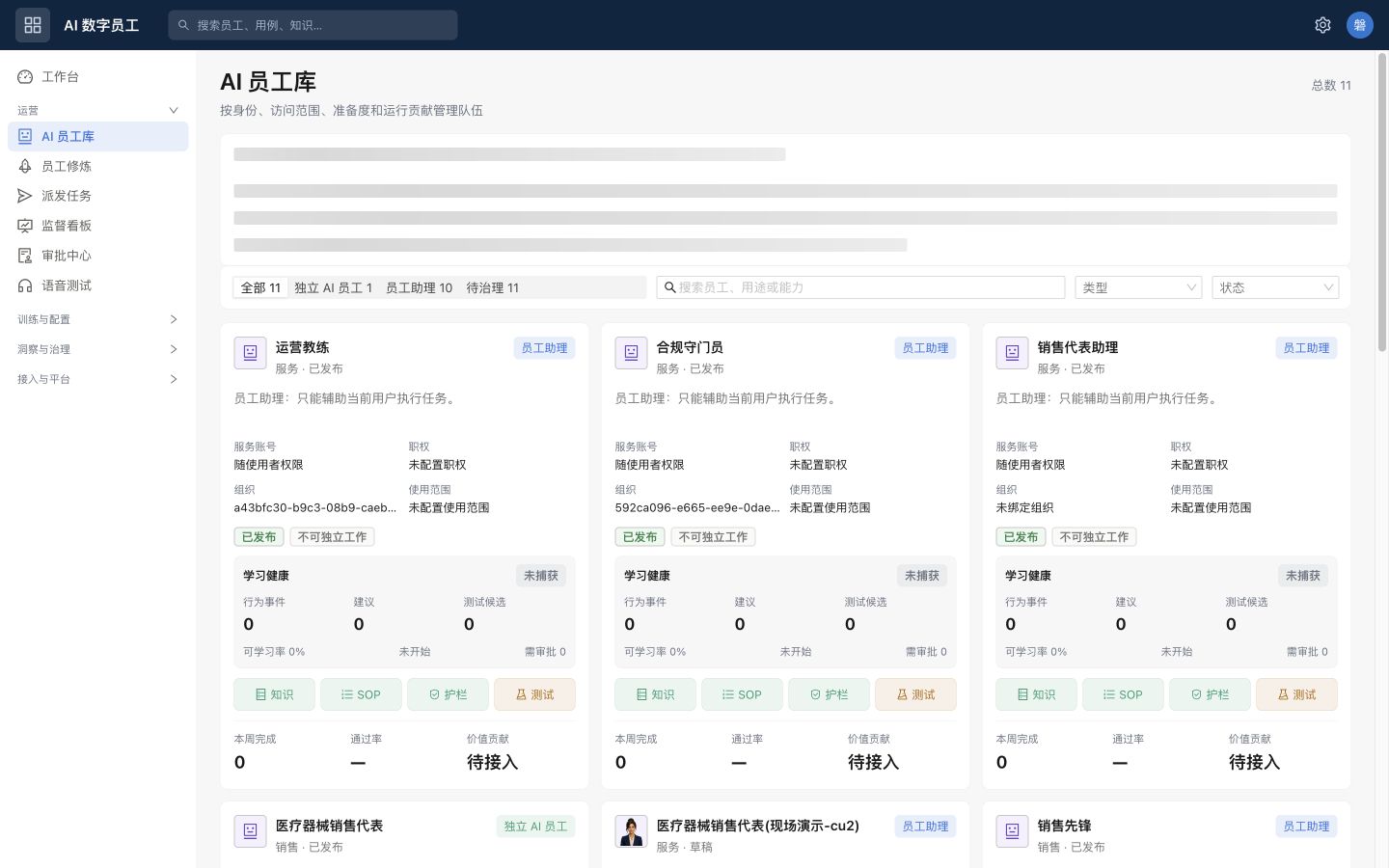
Product UI · AI employee rosterNexusClaw Product UI
NexusClaw AI employee roster showing independent employees and assistants
Employee cards expose identity, service account, role, organization scope, readiness, and learning health.

02 / Employee Builder

A digital employee is not one prompt. It is a testable, publishable work definition.

The builder keeps responsibilities and operating boundaries together: topics define the job, actions define approved tools, knowledge and SOPs provide evidence, while guardrails, tests, access, and observability determine production readiness.

01

Identity

Dedicated service account or task-initiator authority

02

Topics

Job responsibilities, scope, and output goals

03

Actions

Tools, skills, and sensitive-operation levels

04

Knowledge / SOP

Sources of truth and standard operating procedures

05

Guardrails / tests

Boundary checks, regression, and readiness

06

Access / observability

Data scope, outcomes, and failure traces

Product UI · Employee work definitionNexusClaw Product UI
NexusClaw digital employee work definition and preview run interface
Topics, actions, knowledge, SOPs, guardrails, tests, access, and preview runs share one workspace.

03 / Governed Execution

Every step from incoming task to business writeback has an owner

The execution engine does not stop at generating an answer. It builds permission-aware context, plans actions, calls tools, passes policy checks, and writes structured outcomes plus evidence back to the business object.

  1. 01

    Task enters

    From a user, event, business record, or external channel.

  2. 02

    Context is built

    Only information allowed by workspace, identity, role, and object access.

  3. 03

    Plan and tool calls

    The goal is decomposed and approved tools run step by step.

  4. 04

    Policy and human gate

    Sensitive actions, exceptions, and high-risk steps pause for control.

  5. 05

    Outcome and evidence

    Business results, tool calls, owners, and audit records are written together.

04 / Human Control & Audit

Governance is the control plane inside execution, not a log added afterward

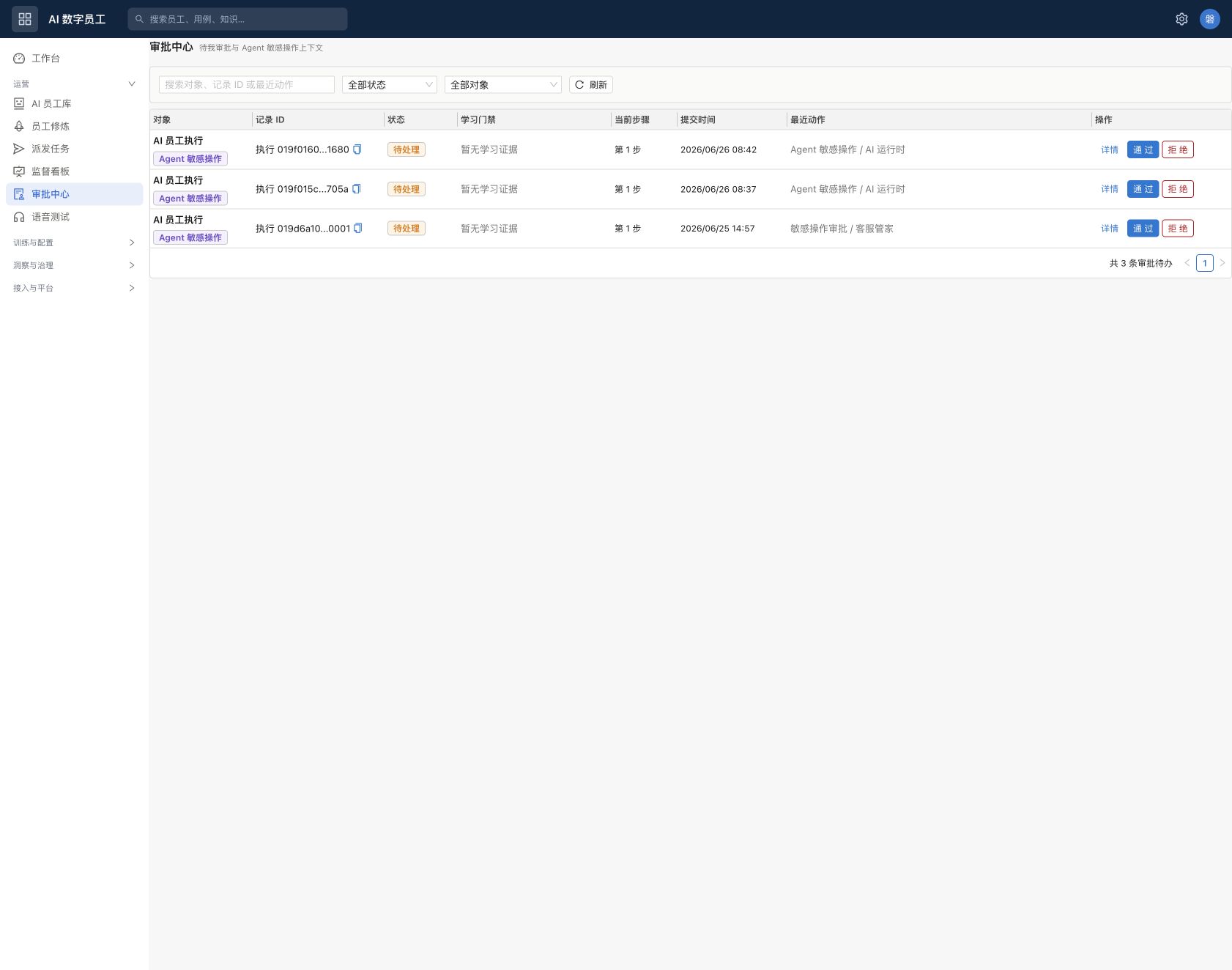
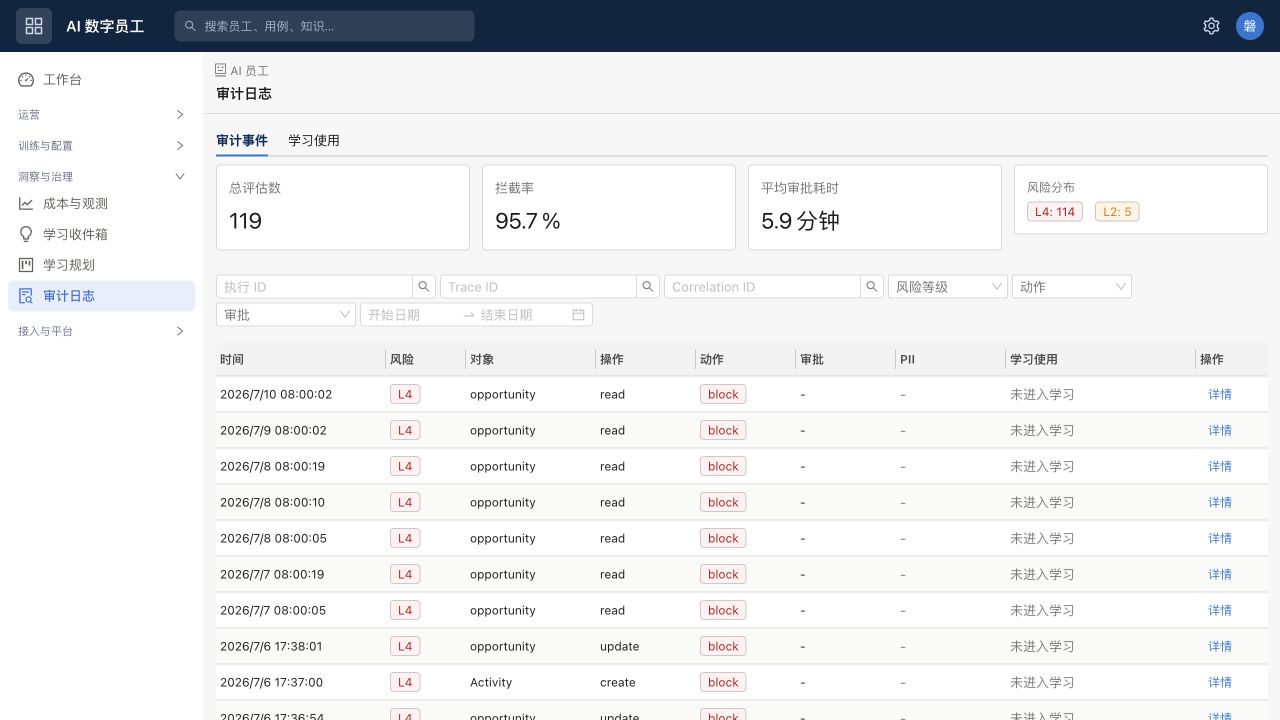
Before a sensitive action runs, the approval center gives an accountable person the risk, object, current step, and recent action. After execution or blocking, audit preserves object, risk, operation, and learning-use evidence.

High-risk actions have an accountable human owner

Approvers can inspect execution context and choose approve or reject. Sensitive work never disappears inside invisible automation.

Product UI · Approval centerNexusClaw Product UI
NexusClaw sensitive Agent action approval center
Pending Agent actions expose object, execution ID, status, step, time, and decision controls.

Every execution can be reconstructed

Events can be filtered by execution, trace, object, risk, and action, including whether evidence entered the governed learning loop.

Product UI · Audit logNexusClaw Product UI
NexusClaw digital employee audit log interface
Execution behavior, risk decisions, blocks, and learning-use state form one evidence chain.

Customer Evaluation Checklist

Four things to validate live before you trust the system

01

Identity changes the authorization subject

Switch identity types and verify the source of authority and configurable controls change together.

02

Unauthorized data never enters context

Task the employee with an out-of-scope object and verify retrieval plus tools deny by default.

03

Sensitive actions pause for people

Trigger a high-risk write and verify an approver can inspect context and take over.

04

Business outcomes trace back to evidence

Start from a result and trace execution, tool calls, approval, and audit records.

Current capability boundary

This page shows current identity, employee configuration, execution-control, and audit surfaces. Digital employees cannot expand their own authority. Behavior improvements require testing, approval, and a release gate; this is not a claim of unsupervised self-evolution.

Bring one real customer workflow to the demo

We will use your roles, object permissions, approval points, and outcome requirements to walk one digital employee from configuration through execution, handoff, and audit.