
Put agents inside the business chain
Context, action execution, and write-back happen inside one governed system instead of stopping at recommendations.
A2A Era
Bring agents into the core business chain—executing, collaborating, governed, attributed, and operationally managed within one unified system
This is not another AI layer added on top of legacy systems. It puts business context, execution, governance, and attribution inside one enterprise operating chain.
Context, action execution, and write-back happen inside one governed system instead of stopping at recommendations.
Permissions, approvals, and human handoff stay in the execution path, ready for production use.
Execution quality, operating cost, and business outcomes stay tied together in one attributable operating model.
A2A Operating View
Context, execution, governance, and operations stay inside one system. Buyers are not looking at a concept poster but at an operating chain that can be evaluated, controlled, and deployed.
Organizes customers, leads, opportunities, service records, and workflow states from enterprise applications into real-time business context that agents can use. Digital workforce must be embedded in these real business objects rather than operating in a contextual vacuum, ensuring every execution is grounded in accurate business data and current state.
Enables agents to execute follow-ups, assignments, records, coordination, and next-step actions within real business workflows, moving beyond answers and suggestions. Supports single-agent task execution, multi-agent collaborative orchestration, and scripted workflow control to ensure complex business processes advance continuously without manual intervention. This is where digital workforce genuinely starts working.
Establishes permission boundaries, approval workflows, human handoff nodes, and audit tracking mechanisms throughout agent execution chains. Every agent action executes within authorized scope, critical decisions preserve human oversight, and the full process is auditable and replayable—forming complete accountability chains that give enterprises confidence to deploy agents in production. Digital workforce does not act without limits, but operates within enterprise rules.
Tracks execution costs, business outcomes, and operational visibility of the digital workforce, connecting each agent behavior to downstream business results for quantifiable ROI analysis. Management gains clear visibility into how AI investment translates to business value, supporting data-driven optimization and scaling decisions. What enterprises ultimately manage is not "how many times AI was called" but "what results the digital workforce created."
A2A Operating View
Context, execution, governance, and operations stay inside one system. Buyers are not looking at a concept poster but at an operating chain that can be evaluated, controlled, and deployed.

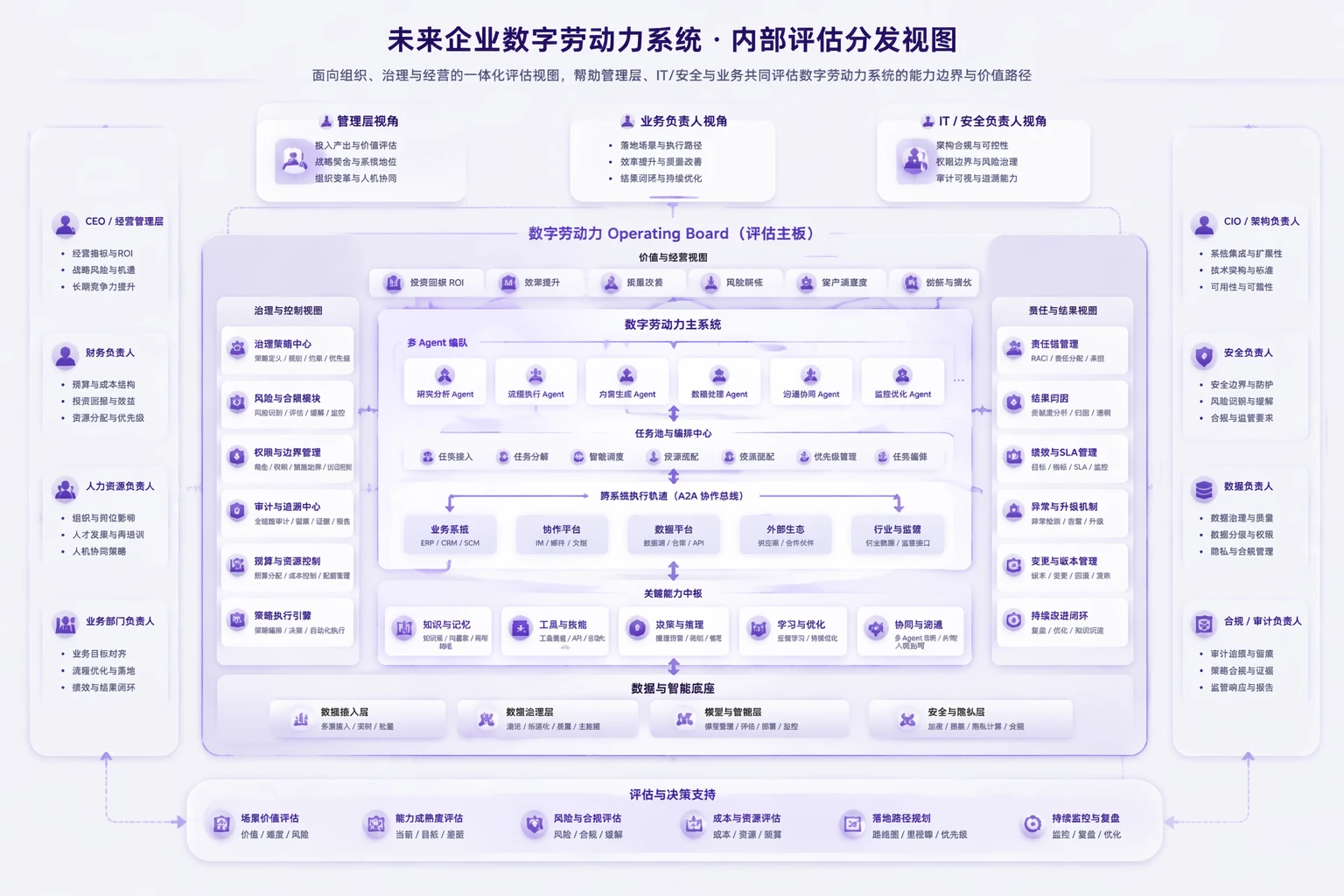
Internal review
It reads like a formal evaluation board instead of a standalone AI concept visual.
Era Narrative
01
Traditional software records what people have done, but in the digital workforce era, systems must manage what machines are doing, why they are doing it, and what results they produce. AI is no longer an add-on assistant—it is digital workforce that genuinely participates in execution, collaboration, outreach, follow-up, judgment, write-back, and business advancement.
02
Agents can call each other, share context, and collaboratively complete complex processes. This is not an efficiency improvement—it is a structural transformation in how enterprises operate. From human-driven processes to agent-coordinated advancement, the underlying logic of business execution is being fundamentally reconstructed.
03
Without an operating system, more agents mean more chaos. Without a governance system, stronger automation means higher risk. Without an attribution system, more results mean more ambiguous accountability. Without an operational system, higher AI costs make ROI harder to justify. What enterprises truly need is not more chatbots, but a digital workforce operating system.
04
We are not adding an AI capability layer on top of traditional systems. Instead, we have redesigned an operating system from the ground up that allows agents to be defined, scheduled, governed, audited, and attributed within enterprise environments—forming a truly controllable, production-ready digital workforce system.
05
All agent execution actions, collaboration relationships, permission boundaries, audit records, and business outcomes are managed within the same system. This is not a simple aggregation of features, but a complete digital workforce operating chain that ensures every link across the full lifecycle is controllable, visible, and traceable.
06
NexusClaw has been designed to production-grade standards from day one, with complete permission control, audit tracking, human handoff, and outcome attribution capabilities. Enterprises can confidently deploy it into real business processes rather than only demonstrating concepts in sandbox environments that never reach production.
Chatbots remain at the conversation layer, unable to execute real business actions within permission boundaries or form auditable execution chains.
Plugins remain at the interface layer, unable to access deep business context or integrate with governance, audit, and attribution systems.
RPA executes fixed scripts without contextual understanding or dynamic judgment, unable to handle complex and evolving enterprise scenarios.
General agent platforms lack enterprise-grade governance boundaries, unable to execute critical business tasks under permission, approval, and audit constraints.
Demo systems can only showcase concepts, unable to support real business processes requiring permission control, audit tracking, and outcome attribution.
Unifies agent definition, scheduling, execution, governance, audit, and attribution in one platform, forming a controllable digital workforce operating system.
Every agent action executes within permission boundaries, critical nodes preserve human handoff, and the full process is auditable and replayable.
Provides real-time context based on enterprise business objects and process states, enabling agents to understand business scenarios and make accurate judgments.
Connects agent behavior with business results, forming a traceable chain of responsibility that supports operational analysis and continuous optimization.
Architecture
From business objects to execution, governance, and operations, NexusClaw uses a four-layer architecture to support the complete operation of enterprise digital workforce.
01
Organizes customers, leads, opportunities, service records, and workflow states from enterprise applications into real-time business context that agents can use. Digital workforce must be embedded in these real business objects rather than operating in a contextual vacuum, ensuring every execution is grounded in accurate business data and current state.
This layer provides the data foundation for upper-layer execution while receiving result write-backs, creating bidirectional flow between data and actions that keeps business objects continuously synchronized with agent activities.
02
Enables agents to execute follow-ups, assignments, records, coordination, and next-step actions within real business workflows, moving beyond answers and suggestions. Supports single-agent task execution, multi-agent collaborative orchestration, and scripted workflow control to ensure complex business processes advance continuously without manual intervention. This is where digital workforce genuinely starts working.
This layer receives context from the business object layer, requests permission validation from the governance layer, writes execution results back to business objects, and outputs execution logs and cost data to the operations layer.
03
Establishes permission boundaries, approval workflows, human handoff nodes, and audit tracking mechanisms throughout agent execution chains. Every agent action executes within authorized scope, critical decisions preserve human oversight, and the full process is auditable and replayable—forming complete accountability chains that give enterprises confidence to deploy agents in production. Digital workforce does not act without limits, but operates within enterprise rules.
This layer validates permission boundaries before execution, monitors risk thresholds and triggers human handoff during execution, records audit logs after execution, and provides compliance and risk control data to the operations layer.
04
Tracks execution costs, business outcomes, and operational visibility of the digital workforce, connecting each agent behavior to downstream business results for quantifiable ROI analysis. Management gains clear visibility into how AI investment translates to business value, supporting data-driven optimization and scaling decisions. What enterprises ultimately manage is not "how many times AI was called" but "what results the digital workforce created."
This layer aggregates action logs from the execution layer, audit records from the governance layer, and outcome data from business objects—forming complete attribution chains that provide decision support and continuous improvement insights for management.
Core Value
NexusClaw does not just ask whether AI can be used—it answers how AI can be managed, attributed, and operated.
Put agents into the core business chain instead of keeping them in demo or assistant mode. Agents no longer just answer questions or provide suggestions—they read business context, drive key actions, update process states, and write results back to business objects, genuinely participating in core workflows like sales follow-up, service response, and process execution.
A manufacturing company deployed NexusClaw to let agents directly participate in channel partner opportunity follow-up. From lead assignment to next-step recommendations, agents drove the entire process while sales teams only stepped in at critical pricing nodes, improving follow-up efficiency by 40%.
Execute within permission boundaries, preserve human handoff at critical nodes, and keep the full chain auditable. Each agent can only access authorized objects and fields, with all actions completed within preset permission policies. This is not post-deployment control—boundaries are defined before execution, ensuring agents never access sensitive data without authorization or perform high-risk operations beyond their scope.
A financial services client used permission policies from day one to restrict agent access to high-net-worth customer data and enforced mandatory human approval for large transaction recommendations, ensuring compliance requirements were met at the execution layer.
Connect every agent execution to downstream business outcomes and form a verifiable accountability chain. Every action an agent takes, every record it updates, every approval it triggers is written to the audit chain and linked to specific business objects and outcome metrics, enabling teams to trace back "how this result was formed" and "what role the agent played."
A SaaS company used NexusClaw's attribution layer to discover that high-intent leads driven by agents converted 25% better than manually followed leads, and could precisely identify which agent actions—like timely responses and accurate recommendations—were critical to conversion.
Track cost, impact, and operational visibility so AI investment can be genuinely managed and optimized. Enterprises can see not only how many tasks agents executed, but also each agent's operating cost, execution quality, business contribution, and optimization opportunities—managing digital workforce like human resources and continuously improving ROI.
A retail enterprise used NexusClaw's operations dashboard to find that customer service agents handling return and exchange inquiries cost only 15% of human labor while maintaining equivalent customer satisfaction levels, leading them to adjust their human-agent collaboration strategy accordingly.
Outcomes
Digital workforce does not stop for off-hours, vacations, or queues. It continuously drives lead follow-up, service response, and process coordination forward, letting steps that once required manual chasing flow automatically and significantly reducing task stall time and coordination overhead.
Agents automatically trigger next-step actions based on business context and execution rules without waiting for human intervention to advance process nodes.
Every agent read, decision, action, and result is recorded in a unified execution chain. Teams can review what context an agent operated in, what decisions it made, which tools it called, and which approvals it triggered, forming a complete traceable record instead of black-box execution.
The platform includes built-in audit chains where all agent actions, tool calls, and state changes are written in real-time to replayable execution logs.
For high-risk operations like large approvals, sensitive data access, or critical customer communication, the system validates permission boundaries before execution and automatically triggers human handoff at key nodes, ensuring agents never exceed authority or complete high-risk actions unsupervised.
The governance layer validates permission policies before agent execution and automatically routes to human approval or handoff when preset risk thresholds are triggered.
Enterprises can quickly replicate validated agent templates to new teams, scenarios, or regions. Orchestration capabilities let multiple agents work together without rebuilding for each scenario, significantly reducing custom development costs and deployment cycles during expansion.
The platform provides reusable agent templates and an orchestration engine supporting rapid cloning, parameterized configuration, and cross-scenario deployment.
Every agent execution connects to downstream business results like lead conversion, service closure, and process completion rates. Leadership can clearly see where AI investment generated value and which scenarios need optimization, forming a sustainable operating improvement loop.
The attribution layer links agent behavior to business object changes and outcome metrics, generating traceable investment-to-outcome analysis reports.
NexusClaw is the enterprise digital workforce operating system for the A2A era—bringing agents into the core business chain, executing, collaborating, governed, attributed, and operationally managed within one unified system.