NexusClaw
NexusClawAI-Native CRM / Post-CRM

Sales, service, and operations teams

Give enterprises governeddigital labor they can actually run

NexusClaw is not a traditional CRM, and it is not CRM with AI features layered on top.

It is an AI-native CRM and Post-CRM autonomous brain designed to replace human CRM cognitive work across relationship memory, state inference, commitment tracking, blocker detection, and next-best-action planning inside one governed execution system.

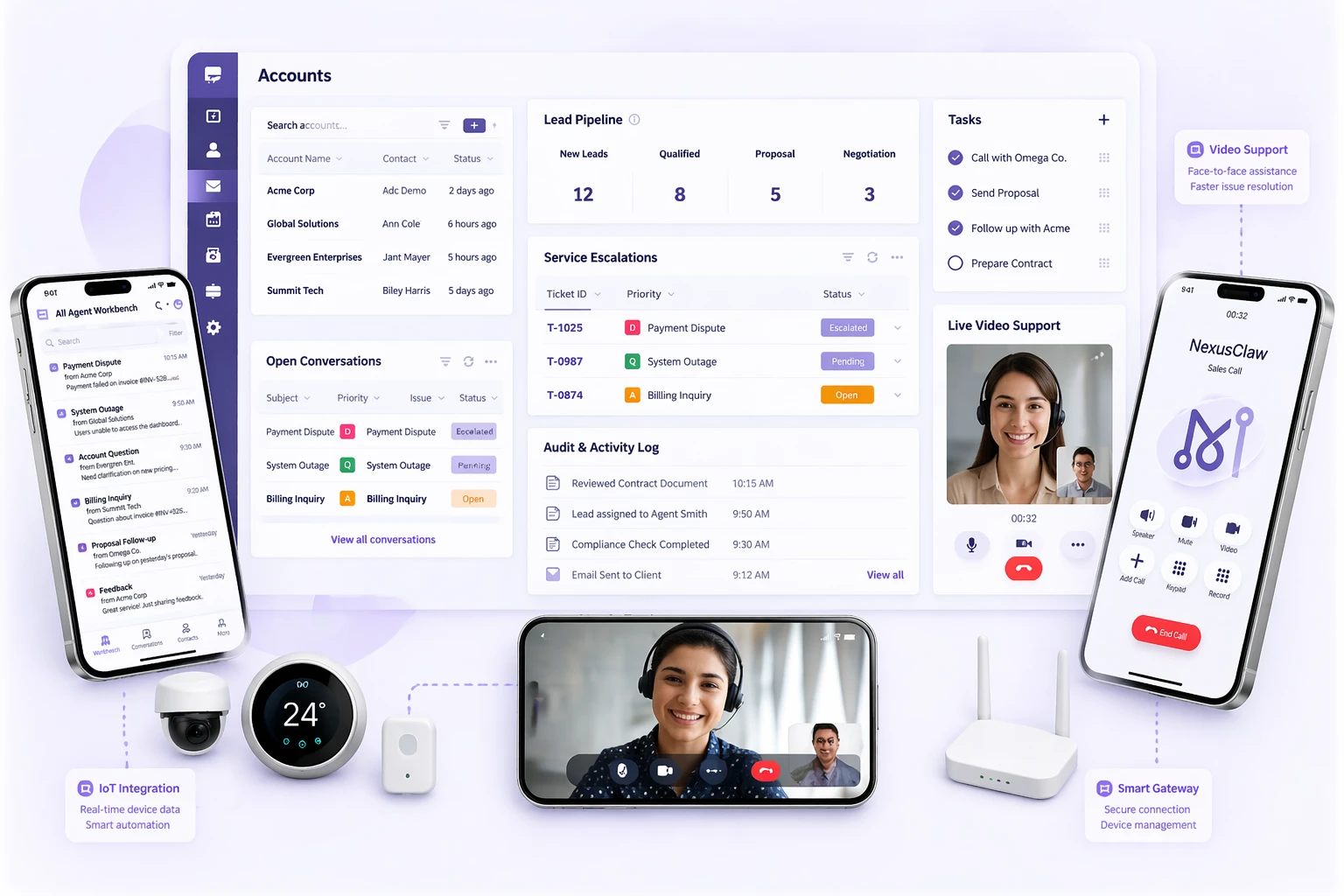
NexusClaw hero dashboard
NexusClaw mobile workspace
NexusClaw mobile call workspace

Executable

Move lead routing, task progression, service escalation, and delivery coordination inside real workflows.

Governed

Roles, permissions, rules, and human takeover keep agent execution controllable in production.

Attributable

Every action, result, and ownership checkpoint stays recorded instead of ending at “AI was involved.”

Platform Overview

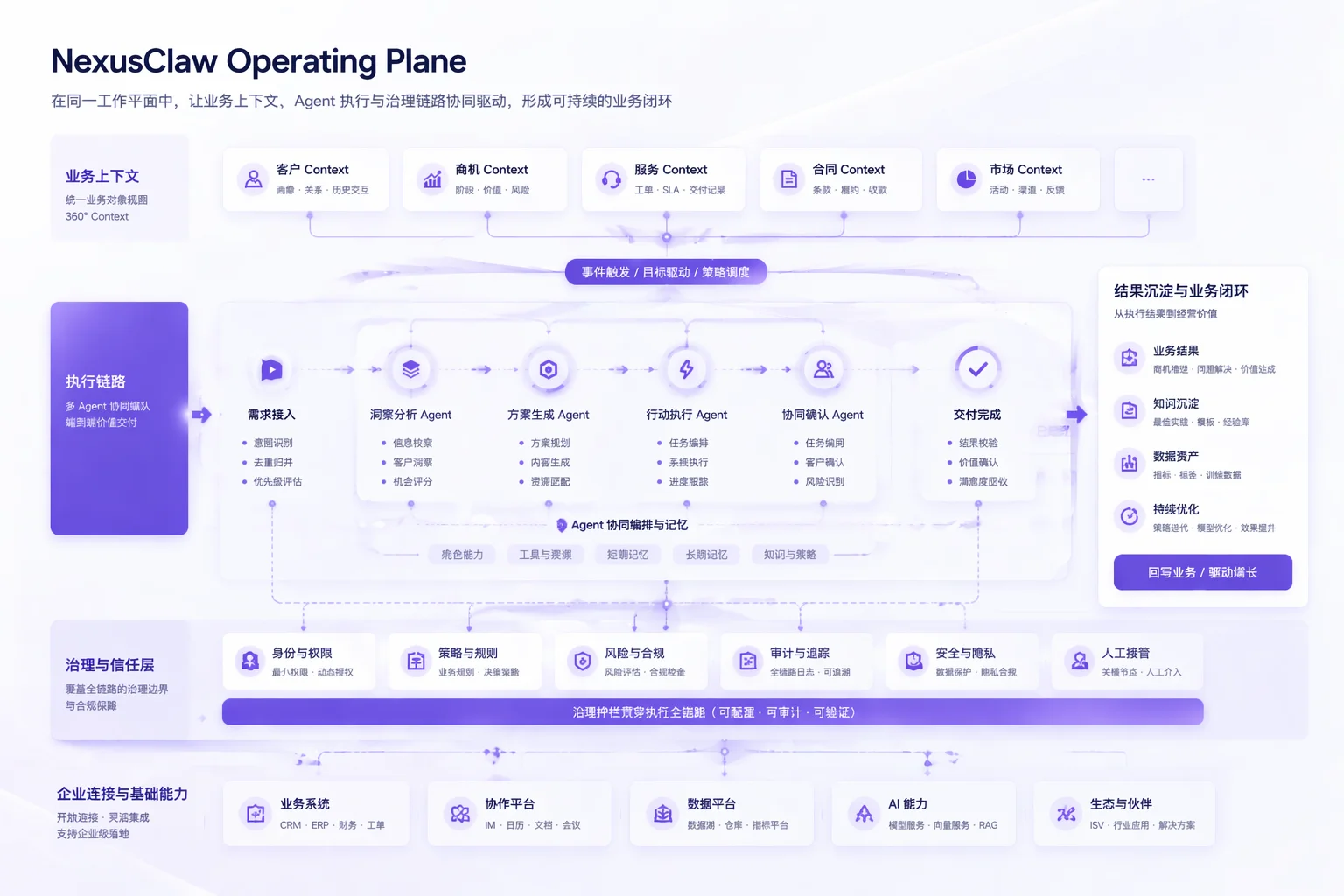
See how NexusClaw brings context, execution, and governance into one operating plane

Following the reference layout, the homepage now moves into a featured product card first, then grouped capability cards and scenario blocks.

Platform Foundation

Platform capability matters because it supports the buying logic above

These platform capabilities support execution, control, and long-term expansion in one production system.

Role-based permissions first

Full audit trail by default

Human handoff at the critical step

NexusClaw platform overview

01

Custom objects and business modeling

02

Roles, permissions, and sharing

03

Workflow and operational execution

01

It removes workflow stitching across CRM, automation, and AI tools

Context, execution, permissions, human handoff, and auditability stay inside one system so teams do not have to patch CRM, automation, and AI tools together to keep work moving.
02

It moves work forward instead of stopping at recommendations

Lead priority, next-step generation, writeback, and exception routing happen inside the workflow instead of leaving people to translate AI output into manual follow-through.

03

It starts with production control instead of adding it after rollout

When agents touch customers, write data, or move workflows, teams need to know who can approve, who can intervene, and how every action will be reviewed later. NexusClaw starts there.

Recommended

Explore the platform

Understand how objects, workflows, execution, and governance connect.

Architecture

Bring execution, governance, and platform foundation into one enterprise system

When customer context, workflow progression, control boundaries, human handoff, and platform capability live in one system, teams can put agents into production with confidence.

Why teams evaluate NexusClaw first

It removes the need to stitch CRM, automation, and AI tools into one brittle process
Critical actions are checked against permissions and policy before execution
Exceptions move to accountable people before they become operational risk
Every action and outcome stays traceable for review, control, and internal audit
It fits existing business systems instead of forcing a full reset first

How production is supervised and optimized

Role-based permissions first

High-risk actions do not run first and get reviewed later. The system checks who can do what before execution.

Full audit trail by default

Actions, outcomes, and human intervention stay in one log for review, internal control, and follow-up.

Human handoff at the critical step

When a workflow becomes risky or commercially important, it moves to an accountable owner immediately.

Where the system gets used

Business context enters the system first

Leads, accounts, opportunities, service cases, tasks, and workflows become structured operating context that agents can read and use.

Agents move work inside defined rules

The system can prioritize work, trigger next steps, update state, and move workflows while staying inside role, policy, and approval boundaries.

Governance decides what can run before it runs

Role-based permissions, policy boundaries, and approval rules determine which actions can move forward before an agent touches a high-risk step.

How the platform helps teams build fast

Custom objects and business modeling

Shape the system around your own customer, service, pipeline, and project structures instead of adapting to rigid templates.

Roles, permissions, and sharing

Control data access and action scope through enterprise access logic from day one.

Workflow and operational execution

Turn process from something that gets recorded into something that gets advanced.

Agent configuration and guardrails

Give agents room to act while keeping them inside explicit operational boundaries.

Auditability, visibility, and attribution

Track execution clearly and measure what outcomes agent participation influences.

Integration and extensibility

Connect existing systems so NexusClaw becomes part of the operating stack instead of becoming another isolated tool.

Use Cases

Explore how NexusClaw enters real teams and evaluation paths

This section follows the reference use-case grid and combines core scenarios with evaluation entry points in one browseable card matrix.

NexusClaw sales workflow

Sales teams

Stop losing high-intent leads to manual routing and slow follow-up

Sales leaders can evaluate whether lead priority, owner routing, next-step follow-up, and writeback happen in one flow, proving the system can reduce switching, reduce waiting, and move pipeline faster.

Explore sales scenarios
NexusClaw service escalation

Service teams

Stop letting service escalation depend on memory and message threads

Service leaders can evaluate whether issue recognition, escalation triggers, human handoff, and auditability live in the same chain, proving risky cases do not drift without ownership.

Explore service scenarios
NexusClaw workflow automation

Operations teams

Stop running cross-team execution on reminders and manual backstops

Operations leaders can evaluate whether task progression, status sync, exception escalation, and result attribution can be system-driven, proving cross-team execution can move beyond reminders and manual backstops.

Explore operations scenarios

Resources

Go deeper into NexusClaw based on what you need next

You can move from platform to scenarios to evaluation materials and then into demo, keeping the path clear without overload.

Recommended

Explore the platform

View platform

Understand how objects, workflows, execution, and governance connect.

NexusClaw = AI-native CRM + Post-CRM autonomous brain + governed execution layer

Entry & Touchpoints

Website / Private Channels / Partners

Enterprise Messaging

Business Experience

CRM / Marketing / Sales

Service / Flow / Reporting

Agent Runtime

Router / Planner

Executor / Tools

Core Business Capabilities

Customer / Opportunity / Order

Activity / Service / Objects

AGL Governance

Permission / Audit / Attribution

Budget / Risk / HITL

Data & Knowledge Foundation

DB / Event Bus

RAG / Files / Logs

Next Step

Review solutions

Evaluate fit by scenario, workflow, and operating priority.

View solutions

Next Step

Download the evaluation brief

Share a concise summary for internal review and early project framing.

Get brief

Next Step

Book a product demo

See the product path in detail when your team is ready for a deeper evaluation.

Book demo

Closing

Move CRM from record keeping to an autonomous brain

If your team is evaluating AI-native CRM, Post-CRM, and autonomous CRM brain systems, NexusClaw brings relationship cognition and governed execution into one enterprise foundation.

AI-native CRMPost-CRMAutonomous CRM BrainCRM cognitive work automationGoverned execution

NexusClaw replaces human CRM cognitive work.